

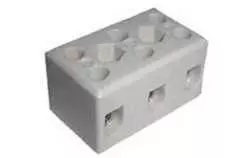
Ceramic Terminal Blocks — High-Temperature, UL Recognized
A ceramic terminal block uses a ceramic (steatite/porcelain) insulating body instead of thermoplastic, so it keeps insulating and holding its clamp in high-temperature environments — heaters, ovens, furnaces, kilns and lighting — where even flame-retardant UL94 V-0 plastics would soften. Shining's TC ceramic series are UL Recognized Components (UL & cUL) under File E257927.
Why ceramic instead of plastic?
It comes down to temperature. A standard plastic body — even one rated UL94 V-0 (flame-retardant, self-extinguishing) — is limited by the plastic's continuous-temperature rating. A steatite ceramic body is non-combustible and keeps its mechanical and dielectric properties at far higher sustained temperatures. Use ceramic where the process or ambient heat exceeds what a thermoplastic body can take; use plastic for general panel and control wiring.
Where ceramic terminal blocks are used
- Cartridge and band heaters / heating elements
- Industrial ovens, furnaces, kilns and dryers
- Lighting fixtures and high-temperature luminaires
- High-temperature sensors and appliances
Ceramic (TC) vs plastic (TCP / standard)
| Ceramic (TC) | Plastic (TCP / standard) | |
|---|---|---|
| Body material | steatite ceramic | thermoplastic (UL94 V-0) |
| Sustained temperature | high — for hot processes | limited by the plastic rating |
| Flame behavior | non-combustible | flame-retardant (self-extinguishing) |
| Best for | heaters, ovens, furnaces, lighting | general panels, control wiring |
| UL | Recognized, File E257927 | Recognized, File E257927 |
Our ceramic range (UL Recognized, File E257927)
| Series | Rated current | Rated voltage | Poles | Body |
|---|---|---|---|---|
| TC-615 / 630 / 645 | 15 / 30 / 45 A | 600 V | 2–4 P | ceramic |
| TC-630 / 650 / 665 | 30 / 50 / 65 A | 600 V | 2–4 P | ceramic |
| TC-660 | 60 A | 600 V | 2–4 P | ceramic |
| TC-6100 | 100 A | 600 V | 2–3 P | ceramic |
| TC-6060D / TC-6100D | 60 / 100 A | 600 V | 1–99 P (modular) | ceramic |
| TCP-630 / 650 / 665 | 30 / 50 / 65 A | 600 V | 2–4 P | plastic (from TC-6xx) |
How to choose
Select by required continuous temperature first (ceramic vs plastic), then rated current, pole count and mounting. If your application runs hot, ceramic protects against softening and loss of clamp force; for normal panels, the plastic TCP counterpart is lighter and lower cost.
The manufacturer's angle
We make boththe ceramic (TC) and the plastic (TCP) versions from the same design, so you can match the body to the heat without changing footprint. OEM/custom, low MOQ (50/100/200), and UL Recognized (UL & cUL), File E257927.
FAQ
What is a ceramic terminal block?
A terminal block with a ceramic (steatite/porcelain) insulating body instead of plastic, used for high-temperature applications where thermoplastics would soften.
Why use a ceramic terminal block instead of plastic?
For sustained heat. A plastic body — even UL94 V-0 — is limited by its temperature rating; steatite ceramic is non-combustible and holds up at far higher temperatures.
What temperature can a ceramic terminal block handle?
Much higher than a thermoplastic body; the exact continuous-temperature rating depends on the series, so confirm it on the datasheet.
Are Shining's ceramic terminal blocks UL certified?
Our TC ceramic series are UL Recognized Components (UL & cUL) under File E257927. Verify the exact model in UL Product iQ. We do not hold IEC or VDE certification.
What are ceramic terminal blocks used for?
Heaters and heating elements, industrial ovens/furnaces/kilns, lighting fixtures and high-temperature sensors.